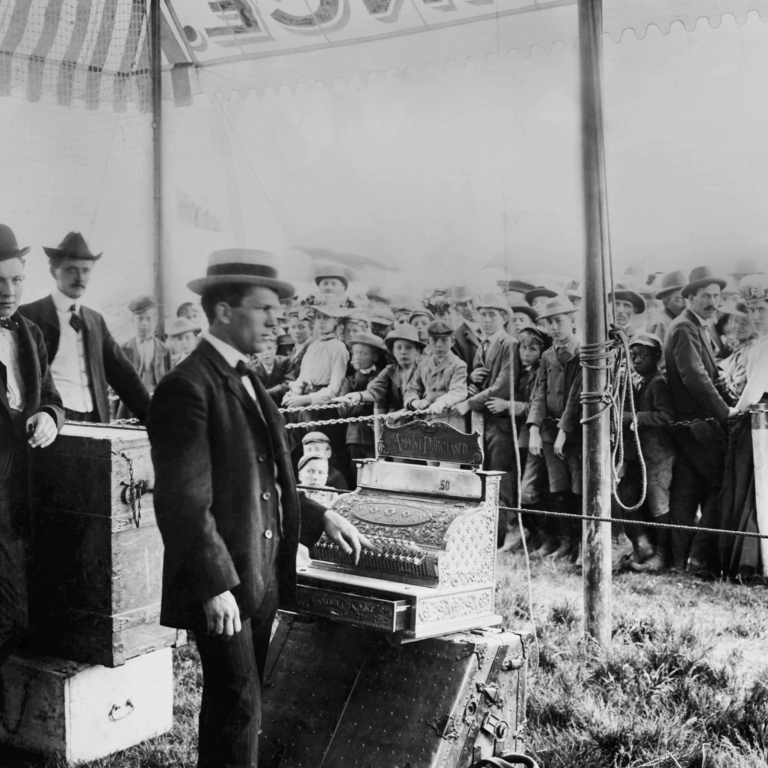

A factory can count the cases it ships without knowing what is happening in the shops. Goods may remain in storage, retailers may build up stocks, and competitors may grow faster even while the manufacturer’s own deliveries increase. Between a company’s accounts and the wider market lies a gap in knowledge. Arthur C. Nielsen’s history concerns the transformation of such gaps into the subject of a specialised commercial service.
Nielsen founded his company in Chicago in 1923. Its starting point was not the television rating now so closely associated with the name. The early business investigated the performance of industrial equipment. Its subsequent importance emerged through expansion and adaptation: a testing organisation developed into a supplier of recurring information about markets (Nielsen, n.d.; NIQ, n.d.).
For marketing history, this development matters more than any single metric. Nielsen helped make systematic market observation available as an ongoing service. Manufacturers could supplement their own figures, sales representatives’ reports and occasional studies with externally collected evidence. The story did not, however, begin with the worldwide invention of market research in 1923. Its predecessors and parallel developments are essential to understanding what was distinctive about Nielsen’s contribution.
Why 1923 was not the birth of market research
The claim that Nielsen invented market research in 1923 is historically excessive. Manufacturers, publishers and advertising agencies were already investigating customers and selling conditions. Charles Coolidge Parlin at the Curtis Publishing Company is an especially well-documented predecessor. Research there began in 1911, and surviving records include work concerning agricultural machinery and department stores (University of Pennsylvania Libraries, n.d.).
The methodological literature also predated Nielsen’s incorporation. In 1919, Carson S. Duncan published Commercial Research: An Outline of Working Principles. It addressed sources of information, field investigation, analysis and the organisation of research. Commercial inquiry was already being discussed as a planned activity rather than an improvised conversation with a few customers (Duncan, 1919).
The more useful question is therefore which form of research Nielsen strengthened. His significance lies particularly in building an organisation that supplied repeated measurement to businesses. He participated in a developing field whose contributors addressed different information problems. The founding date marks an important institutional development, rather than the first occasion on which anyone deliberately collected information to understand a market. This distinction makes the achievement more precise without diminishing it.
The industrial testing business of 1923
The corporate chronologies describe an engineer using borrowed capital to establish a business investigating industrial equipment. NIQ identifies 24 August 1923 as the incorporation date of the A.C. Nielsen Company. The older Nielsen timeline mentions conveyor belts and turbine generators among the early objects of investigation (NIQ, n.d.; Nielsen, n.d.).
The technical origin is revealing. Testing equipment involves more than accepting a supplier’s assertion; a procedure is intended to make performance open to examination. A related orientation can be recognised in market inquiry: decisions should rest on observations collected systematically. This is an interpretation of the relationship between the early activities, not a claim that engineering tests and consumer research are methodologically identical.
Their differences were substantial. A machine may be investigated under specified conditions. A market involves people, organisations and changing circumstances. Researchers must decide whom to observe, what to count and which differences matter. Nielsen’s engineering background therefore helps explain an orientation towards measurement. It does not by itself explain how every later research problem was solved. The commercial expansion required new objects of inquiry as well as additional procedures and organisational capabilities.
Performance surveys and market surveys asked different questions
The timelines distinguish early performance surveys from subsequent market surveys. NIQ dates a market investigation for a steel producer to 1927. The older Nielsen chronology identifies 1929 with an initial consumer-market survey (NIQ, n.d.; Nielsen, n.d.). These stages should not be collapsed into a single event at the company’s foundation.
The distinction is substantive. Testing an industrial product’s performance initially concerns a property of the offering. Investigating a market concerns potential buyers, demand, competition or distribution. A technically successful article may address a small market. Conversely, substantial demand does not establish that a particular supplier can satisfy it profitably.
Nielsen’s development shows research assignments broadening. A business needed to understand not only whether something worked, but who might require it and under what conditions selling it made sense. Later consumer research extended this second line of inquiry without being reducible to it. Keeping these questions separate also avoids a retrospective simplification in which everything the company subsequently became appears already complete in its first year. Its eventual role was constructed through successive additions rather than revealed all at once.
What manufacturers could not learn from their own accounts
Why could outside information become valuable? Internal records primarily reveal transactions in which the organisation participates. They describe its orders, output and deliveries. They provide much less direct information about customers who never buy from it or the fortunes of competing products.
Duncan discussed multiple internal and external sources of business information in 1919. His treatment makes clear that commercial research was not simply an exercise in collecting more numbers. Sources had to be selected and combined around a definite business problem (Duncan, 1919, chs IV-VI).
Consider an illustrative case. A manufacturer sees deliveries rising. That may indicate growing consumer demand, but it may also reflect retailers accumulating stock. Both explanations remain possible without further evidence. External observation gains value by extending the perspective of the company’s accounts. Historically, the important transition is from knowing what happened inside one organisation to investigating its position within a wider system of exchange. Nielsen did not eliminate the usefulness of internal information. The developing research business supplied a different perspective that internal records alone could not readily provide.
Market research had to establish its own market
A study may be intellectually interesting without finding a paying customer. Research providers had to explain why information deserved a budget. Its commercial value often appeared only through decisions made after the investigation, making the service less tangible than a machine or a shipment of goods.
Douglas B. Ward’s account of Curtis Publishing places early organised research within the publisher’s commercial relationships. Knowledge of readers and consumers could provide added value for advertisers. Research was therefore not outside economic interests; it was part of a business model (Ward, 2010).
This predecessor helps contextualise Nielsen. Demand for research does not arise merely because collection becomes technically possible. A prospective client must recognise a consequential decision, acknowledge uncertainty and regard the expected knowledge as worth its cost. Building a research industry consequently involved legitimising a profession as well as delivering findings. Providers sold a disciplined way of knowing in a business environment where experience, personal judgement and sales contacts already had authority. Their task was to demonstrate what systematic investigation could add to those established resources.
A single study answers a question; a recurring series changes routines
A one-off investigation and a repeated measurement service have different organisational effects. A study may inform a launch or a specific investment. A series makes it possible to follow changes across successive periods and can become part of everyday management.
Nielsen’s movement from commissioned investigations towards indices exemplifies this difference. The corporate histories describe early-1930s work in drug retailing followed by additional retail categories. The developing offer increasingly depended on repeated observation rather than isolated consulting assignments (NIQ, n.d.; Nielsen, n.d.).
The consequence can be explained analytically. A new finding may surprise management; a continuing series also creates an expectation of the next report. Users can examine whether a movement persists or reverses. At the same time, regular reporting stabilises particular categories and directs attention towards particular problems. A measurement service can thus become part of a company’s calendar, vocabulary and decision process. Its influence extends beyond the immediate contents of a table because it helps organise when questions are asked and what counts as evidence in answering them.
The Depression and a change in business direction
Nielsen’s corporate histories place the stronger move towards consumer-sales measurement during the Great Depression. NIQ describes 1933 as the point at which the organisation became exclusively a consumer-intelligence provider. That date should be distinguished from the earlier exploratory assignments (NIQ, n.d.).
The economic-historical significance does not require treating crisis as an automatic producer of innovation. Severe disruption can destroy research budgets as easily as encourage new inquiry. It can nevertheless undermine an existing commercial model and increase the relevance of other information problems. Organisations operating under pressure may urgently need to understand where demand still exists.
For Nielsen, the change was also an episode in the history of the research firm itself. Existing capabilities were redirected towards different customer questions. The eventual outcome was not predetermined in 1923. Looking backwards from a famous brand makes it easy to imagine uninterrupted movement towards a known destination. A careful chronology instead preserves changes of emphasis and the time separating them. This produces a more convincing history than attributing every later service to an original plan whose existence has not been demonstrated.
The unglamorous work of making observations comparable
Repeated findings require reasonably stable definitions. What constitutes a product? Which selling places belong to the market under investigation? Are the results expressed in units or money? These apparently technical decisions determine what the reported movement actually means.
Duncan treated classification and presentation as distinct tasks within commercial research. Information had to be arranged so that conclusions could be drawn from it. Tables, charts and other forms of display belonged within that process rather than being decorative additions at its end (Duncan, 1919, chs VII-IX).
The historical importance of a measurement organisation therefore includes routine work that rarely appears in celebratory innovation stories. Collecting observations in many places is not enough. They must fit together through intelligible rules. Only then can dispersed local information support a broader statement. The connection with contemporary data problems is conceptual rather than technical: a large collection becomes useful through the definitions and procedures holding it together. More records cannot compensate automatically for uncertainty about what the records represent or how they were assembled.
A sample is not the whole market
Researchers cannot always observe every transaction or person relevant to their question. They may therefore investigate a part and draw conclusions about a larger population. The movement from observed cases to the wider market is a methodological step, not an automatic consequence of collecting many cases.
Duncan’s 1919 book already discussed selection and sampling. Attention to such problems long preceded contemporary claims about comprehensive digital knowledge (Duncan, 1919, ch. VII). Early research should not be dismissed as intellectually unsophisticated simply because it operated with limited technologies.
An illustrative example shows the issue. If a study observes mainly large city shops, its findings may describe those shops well while representing rural trade poorly. Adding more observations from the same selective setting need not correct the problem. The missing parts of the market remain consequential. This explanation does not allege a particular defect in a specific Nielsen index. It identifies a requirement encountered by any comparable attempt to generalise. Assessing a research service means asking not only how much information it collects, but which economic activities remain beyond its field of observation.
Why client service belonged within the research business
The Nielsen timeline identifies the creation of a client-service team in 1934 to help customers use the company’s information (Nielsen, n.d.). Beside more celebrated technical milestones, the entry may appear modest. Organisationally, it is revealing.
A report does not make a decision on its own. Its users need to understand what is measured, which comparisons are meaningful and where interpretation becomes uncertain. An organisation can purchase extensive information and still misunderstand the market if it misreads the underlying procedure.
The service therefore need not end when a table is delivered. Between collection and action lies a problem of translation. Research must connect with decisions that sales staff, product managers and senior executives can actually make. Conversely, the provider needs to understand the client’s practical constraints. The early appearance of client support shows that this mediation was not invented for modern dashboards. Supplying information and making it usable were related but distinguishable activities. A successful measurement business needed to address both, without implying that interpretation could ever become entirely automatic.
A shared basis for conversations between departments
Different departments encounter the same market from different positions. Sales staff hear retailers’ comments. Advertising personnel observe campaign responses. Senior management examines earnings and growth. An externally collected finding may connect these perspectives without replacing any of them.
Duncan’s chapter on organising research considered work within businesses, associations, advertising agencies and specialist organisations. Institutional placement was already recognised as part of the problem rather than a matter to be settled after the methods were chosen (Duncan, 1919, ch. X).
Shared information can have contradictory effects. It may reduce disagreement about the starting position, but it may also intensify disputes when departments are judged against different measures. Selecting a metric partly determines which contributions are visible. Nielsen’s rise can therefore be interpreted as part of a changing informational order of management. This interpretation adds an organisational perspective to the chronology. It does not claim that external measurement resolved every conflict. Its significance is that comparable evidence could become a reference point beyond the experience or authority of a single department.
Observing purchases is not the same as explaining motives
Sales and motivations answer different questions. Discovering that an article sells more frequently identifies a movement in behaviour. It does not fully establish whether price, availability, routine, recommendation or changed circumstances produced it.
The distinction matters because market research is often equated with asking people questions. Its history encompasses several routes to knowledge. A retail report can reveal something different from an interview in a household. An experiment has different requirements from a continuing descriptive series.
There is little value in treating these approaches as mutually exclusive competitors. A quantitative observation is not useless because it leaves motives unresolved. An insightful account of motivations does not establish how widespread the behaviour is. Nielsen’s contribution particularly concerned making parts of the market more regularly observable. Other forms of investigation addressed complementary questions. Their coexistence helps explain why the history of research cannot be reduced to one company. It is a history of different objects of inquiry and changing combinations of methods, commercial needs and institutional settings.
Earlier American examples: Parlin and Duncan
Parlin is the crucial comparison when 1923 is presented as the beginning of organised business research. The Curtis archive documents investigations from 1911. Ward places that work within relationships between publishing, readership and advertising clients (University of Pennsylvania Libraries, n.d.; Ward, 2010).
Duncan provides a different form of evidence. His book combined the investigation of markets with source criticism, field methods and the question of how organisations should use information. Published by Macmillan in 1919, it demonstrates that methodical commercial inquiry was already substantial enough to receive an extensive book-length treatment (Duncan, 1919).
Both examples are older, but they are not simply earlier versions of exactly the same achievement. Parlin worked within a publishing organisation. Duncan systematised working principles in a text. Nielsen built and expanded a business supplying research services. Ranking these contributions would obscure their differences. The more accurate account distinguishes methodological discussion, commercial organisation and actual field investigation. Each could develop at a different pace, and the existence of one did not guarantee the immediate spread of the others.
Britain: consumer knowledge at Lever and J. Walter Thompson
Schwarzkopf’s CHARM study examines how Lever and J. Walter Thompson used research in Britain. Investigations between 1927 and 1935 supported the development of Lux, demonstrating that consumer inquiry already informed practical brand work during the interwar period (Schwarzkopf, 2007).
The comparison reveals a different institutional location. Knowledge was produced within the relationship between a manufacturer and its advertising agency, not only by specialist external measurement companies. Investigating practices of consumption could produce insights unlike those supplied by a sales series.
This does not diminish Nielsen. It makes the international field visible. Specialist suppliers, internal departments and agencies could perform complementary tasks, even when their methods and commercial incentives differed. What later became recognisable as modern research emerged through several such arrangements. Looking beyond the United States prevents a misleading genealogy in which every important approach descends directly from a single incorporation. The comparison also reminds us that a market can be investigated as a field of human practices as well as an aggregate of recorded transactions.
Germany: a different emphasis in consumer research
The Gesellschaft für Konsumforschung was established in 1934. The present-day Nuremberg Institute for Market Decisions identifies Wilhelm Vershofen, Erich Schäfer and Ludwig Erhard among its founders. Vershofen’s approach emphasised perceived benefits and everyday circumstances, using locally knowledgeable correspondents to investigate purchasing decisions (Neus and Ivens, n.d.).
This institutional retrospective requires the same caution as a company’s own timeline. Claims of worldwide uniqueness cannot be accepted merely because an organisation includes them in its history. As a documented comparison, however, the account reveals a different emphasis: understanding why a decision occurs rather than recording its measurable outcome alone.
The comparison is not a contest between national founding heroes. Markets could be counted, described and interpreted, and a fuller account emerges through relationships between these perspectives. The 1934 date is institutionally significant, but later democratic research ideals should not simply be projected onto all the conditions of that period. Historical context remains necessary even when the subject is a method that looks familiar today. Recognising a contribution does not require removing it from the society in which it developed.
International expansion involved more than translating a report
Nielsen’s chronologies identify a first overseas office in Britain in 1939, followed by Canada in 1944 and Australia in 1948. Additional European operations followed in the 1950s, including Germany in 1954 (Nielsen, n.d.; NIQ, n.d.). The sequence demonstrates the widening geographical reach of the service.
Its methodological implications can be explained without assuming that every national market was identical. Translating category names does not make observations automatically comparable. Retail structures, pack sizes, distribution arrangements and habits may differ. Apparently equivalent labels may consequently refer to different commercial situations.
The expansion of a research business also involves managing differences. Standard procedures facilitate comparison; local adjustments may better represent local realities. Both considerations matter. The later interpretation faces a related challenge: a reported gap between countries can reflect a real difference, a difference in definition or some combination of the two. Comparability is an achievement to be maintained, rather than a quality conferred by international presence alone. This makes organisational expansion a methodological story as well as a story of opening offices.
From consumer goods to the measurement of audiences
Nielsen’s audience-measurement activities developed after the company’s foundation. Its timeline dates the acquisition of Audimeter rights to 1936, the American Radio Index to 1942 and the Television Index to 1950 (Nielsen, n.d.). Television ratings therefore do not belong in a description of the original 1923 offer.
The connection between the activities lies in demand for information. Manufacturers need to understand sales; advertisers also want to know what audiences their media spending may reach. Both involve allocating resources under uncertainty. They nevertheless require different observations and definitions.
This distinction prevents another common simplification. Recording an operating receiving device is not identical to proving conscious attention, and audience reach is not identical to additional product sales. A research brand’s familiarity cannot erase these differences. The historical expansion demonstrates the addition of new measurement problems, rather than the discovery of one number explaining all marketing effects. Understanding the separate questions is essential to appreciating both the value and the limits of the company’s widening role in advertising decisions.
What measurement makes visible, and what it leaves outside
A measurement system describes commercial activity while selecting the parts that become routinely visible. Products, channels and groups fitting its definitions appear more clearly. Other activities may be difficult to capture within the same structure.
This is not an objection to standardisation as such. Every observation needs boundaries. Problems arise when users forget them and treat the report as equivalent to the whole market. A measure can be dependable for its defined object while leaving a broader question unanswered.
For marketing history, the consequences are twofold. Research suppliers expanded the available stock of knowledge. Their categories also helped shape the language in which organisations discussed customers and competition. This analytical conclusion explains why the rise of research was more than an improvement in technical observation. It influenced which questions could be asked routinely, what evidence appeared persuasive and which differences remained difficult to articulate. Information infrastructure can make better decisions possible without making every decision obvious or every relevant part of the market equally visible.
An important contemporary check on the founder story
Duncan supplied particularly direct evidence against the claim that Nielsen was the first business ever to offer commercial research. In 1919, he already discussed specialist business research companies, including local and national investigations. He also distinguished their work from the uncertain promise of business forecasting (Duncan, 1919, ch. X, pp. 316-318).
His book even criticised a map whose arrows dramatised Chicago’s importance as a trading centre without adequately proving the implied conclusion. The difference between persuasive visualisation and valid evidence was therefore already recognised before Nielsen’s incorporation (Duncan, 1919, ch. IX, pp. 281-282).
The wider field later developed additional explanatory approaches. Fullerton’s account in the Journal of Historical Research in Marketing examines how motivation research in the 1940s and 1950s drew on sociology, anthropology and psychology to understand consumption (Fullerton, 2013). These examples reinforce a differentiated history: external research organisations, critical interpretation and inquiry into motives had related but distinct trajectories. Nielsen’s influence does not depend on treating them as one invention.
Beyond the simple production, selling and marketing sequence
The earlier history fits poorly with a rigid account in which businesses first produced, then sold and only after the Second World War discovered customers. Jones and Richardson critically examined a marketing-revolution narrative using older source material (Jones and Richardson, 2007).
Nielsen’s foundation, Parlin’s work and Duncan’s text support a more differentiated picture. Customer knowledge, advertising planning and sales analysis existed in varied forms before they became widely institutionalised. Their later expansion does not establish that all earlier organisations were indifferent to demand.
The historical span of Schwarzkopf’s contribution on research from 1890 to 1960 in The Routledge Companion to Marketing History similarly identifies a longer period of investigation (Schwarzkopf, 2016). This is the value of careful marketing history: broad stages give way to identifiable actors, methods and conditions. Nielsen’s contribution becomes more accurately locatable. It can be distinguished from earlier achievements rather than inflated through the assumption that nothing comparable existed beforehand. Institutional growth is important without having to function as an absolute beginning.
Reading the names Nielsen and NielsenIQ historically
Present-day corporate sources require one further distinction. On 5 March 2021, Nielsen announced completion of the sale of its former Global Connect business, continued as NielsenIQ. The organisations consequently refer to common historical roots without being interchangeable descriptions of their subsequent corporate structures (Nielsen, 2021).
When discussing 1923, there is no need to rename the past after a later transaction. The A.C. Nielsen Company can be identified as the historical actor, while the publisher of each contemporary retrospective is named accurately.
This is more than bibliographical tidiness. Corporate histories select milestones relevant to a later identity. Agreement between retrospectives can strengthen confidence in a chronology, but it does not independently confirm every claim to priority. Assertions that a firm invented a method require more evidence than assertions that it supplied a particular service at a particular date. Separating those claims allows the historical narrative to use corporate sources without adopting their entire account of their own significance.
Nielsen’s lasting contribution to marketing history
Arthur C. Nielsen’s importance lies in making systematic market observation an enduring commercial activity. An investigation business founded in 1923 gradually developed into a supplier of recurring information used in ongoing management. Its influence is best understood as the construction of an information infrastructure.
The limits belong within that history. Recorded sales do not reveal every motive. A time series does not establish an advertising effect. An international report does not make market conditions identical. A respected name does not remove the need to examine definitions and procedures.
These qualifications clarify rather than diminish the achievement. Nielsen did not abolish uncertainty. His business made selected economic activities more regularly observable and comparable. Manufacturers, retailers and advertisers could use that evidence to formulate more precise questions. The decisive change was not that marketing suddenly knew everything. It acquired an organised, continuing means of asking the market for information beyond the boundaries of an individual company’s own experience.
References
Duncan, C.S. (1919) Commercial Research: An Outline of Working Principles. New York: Macmillan. Available at: https://archive.org/details/commercialresear00dunc (Accessed: 21 October 2026).
Fullerton, R.A. (2013) ‘The birth of consumer behavior: Motivation research in the 1940s and 1950s’, Journal of Historical Research in Marketing, 5(2), pp. 212-222. https://doi.org/10.1108/17557501311316833.
Jones, D.G.B. and Richardson, A.J. (2007) ‘The myth of the marketing revolution’, Journal of Macromarketing, 27(1), pp. 15-24. https://doi.org/10.1177/0276146706296708.
Neus, A. and Ivens, B. (n.d.) ‘Historical roots, early concepts, and research legacy’. Nuremberg Institute for Market Decisions. Available at: https://www.nim.org/en/about-us/historic-roots (Accessed: 21 October 2026).
Nielsen (n.d.) ‘Celebrating 95 years of innovation’. Available at: https://sites.nielsen.com/timelines/our-history/ (Accessed: 21 October 2026).
Nielsen (2021) ‘Nielsen announces completion of sale of Global Connect business to Advent International’, 5 March. Available at: https://www.nielsen.com/news-center/2021/nielsen-announces-completion-of-sale-of-global-connect-business-to-advent-international/ (Accessed: 21 October 2026).
NIQ (n.d.) ‘Our history’. Available at: https://nielseniq.com/global/en/landing-page/our-history-niq-driving-force-behind-consumer-intelligence/ (Accessed: 21 October 2026).
Schwarzkopf, S. (2007) ‘Consumer voice and brand loyalty: Lever, J. Walter Thompson and the rise of market research in Britain, 1918-1939’, Proceedings of the Conference on Historical Analysis and Research in Marketing, pp. 180-192. Available at: https://ojs.library.carleton.ca/index.php/pcharm/article/view/1583/1427 (Accessed: 21 October 2026).
Schwarzkopf, S. (2016) ‘In search of the consumer: The history of market research from 1890 to 1960’, in Jones, D.G.B. and Tadajewski, M. (eds) The Routledge Companion to Marketing History. Abingdon: Routledge, pp. 61-83. Bibliographic record: https://research.cbs.dk/en/publications/in-search-of-the-consumer-the-history-of-market-research-from-189/.
University of Pennsylvania Libraries (n.d.) ‘Curtis Publishing Company records’. Available at: https://findingaids.library.upenn.edu/records/UPENN_RBML_PUSP.MS.COLL.51 (Accessed: 21 October 2026).
Ward, D.B. (2010) A New Brand of Business: Charles Coolidge Parlin, Curtis Publishing Company, and the Origins of Market Research. Philadelphia: Temple University Press. Publisher’s description available at: https://tupress.temple.edu/books/a-new-brand-of-business (Accessed: 21 October 2026).